
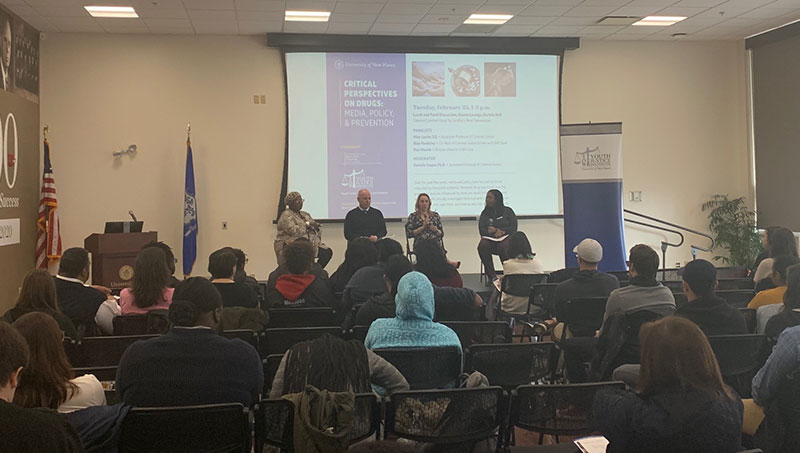
Members of the University community and local activists came together for a discussion about the impact the media and policy can have on curtailing substance abuse.
Marc Conrad ’21, a major, is an adult probation services intern with the state of . With this knowledge and experience in tow, he attended a recent panel discussion at the University of New Haven that explored solutions to drug-use issues.
“At my internship, I see the impact of substance abuse,” he said. “Discussions like this one are very important because drugs are a huge problem. I hope this will lead to a better understanding of how we can apply everything we’ve learned to addressing the problem.”
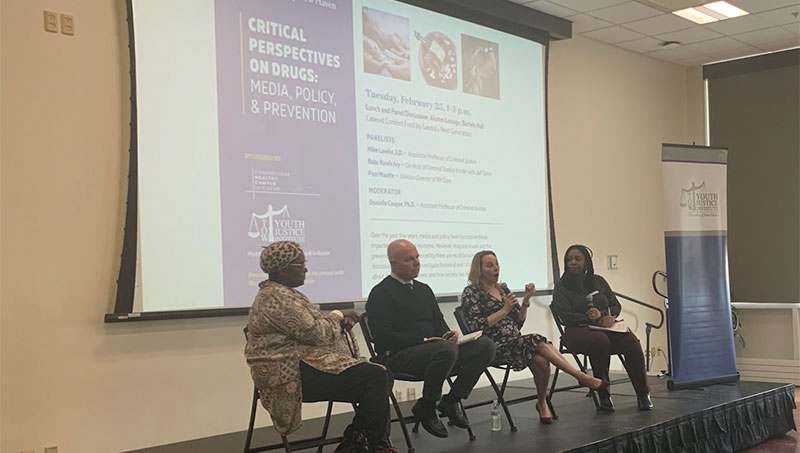
Moderated by , assistant professor of criminal justice at the University, the panel, titled “Critical Perspectives on Drugs: Media, Policy, and Prevention,” explored the roles that the media, public policy, and prevention initiatives have had on the opioid epidemic, as well as broader drug-use issues.”
"An advocacy strategy that I have found to be very effective is encouraging people with lived experience to tell their story."Mike Lawlor, Ph.D.
“Discussions like this are important because we want students to know how to seek – and challenge – a variety of sources for information and informed opinions,” she said. “This conversation could have an impact on their careers. We also want to encourage wellness and encourage healthy activities.”
The panel, which included Babz Rawls Ivy, co-host of the podcast “;” Pam Mautte, division director of , a nonprofit organization; and , a former prosecutor and an associate professor of criminal justice at the University, explored the history and cultural differences of drug use, as well as society’s approach to addressing drug-abuse problems.
“An advocacy strategy that I have found to be very effective is encouraging people with lived experience to tell their story,” said Professor Lawlor, a nationally recognized expert on criminal justice reform who served for more than 20 years as a member of the “When they step forward and share the impact the issue has had on them – which takes a lot of courage – that seems to be an effective way to change people’s minds.”
Jennifer Heisler ’21, one of Professor Lawlor’s students, found the discussion to be a good learning experience.
“This was a great opportunity for students to listen to an important discussion,” said Heisler, a criminal justice major. “We learned more about what is going on in the community, and it offered new perspectives.”
The discussion was sponsored by the , the University’s , and the . The University will be hosting another panel discussion this month – as part of Women’s History Month.
“As a criminal justice major with a juvenile justice concentration, I am very interested in learning more about this,” said Brianna Straiton ’20. “This was a great opportunity for students to learn from professionals outside the classroom.”
Contact
Get the highlights!
Stay up to date with our weekly e-newsletter, highlighting stories from around the University and media clips featuring our faculty experts.
Recent News
The Â鶹AV Blog

Health Sciences and Marine & Environmental Sciences Programs Launch Interdisciplinary Collaboration
University News

University of New Haven Faculty Earn Three Connecticut DOT Research Awards in a Single Year
The Â鶹AV Blog

University of New Haven Student Explores the Power of Peer Support in Youth Mental Health
The Â鶹AV Blog
