Beatrice Glaviano sat down with James Ayers, a distinguished lecturer in biology and environmental science for an insightful conversation about biology, hidden passions, and what it means to keep moving forward.

Author, excruciatingly awkwardly: “So, um…Hi, how are you?” (Cue awkward laughing)
“I’m pretty well. Monday morning. I’m half awake.”
Good morning (or whenever), everyone, and welcome back to the Â鶹AV Blog! I’m still your host, Beatrice Glaviano, and I’d like to introduce a genre of blogging that I thoroughly missed:
Faculty interviews.
This past week, I had the absolute pleasure of interviewing Professor James Ayers, M.S. here at the University of New Haven. Professor Ayers has a strong background in all things biological, including a well-earned B.S. (Biology) from Southern Connecticut State University and M.S. (Ecology, Evolution, and Behavior) from Purdue University.
As one of his current students, I met Professor Ayers in his Socioeconomic Inequalities (H) course that is co-taught by . Originally, I wasn’t sure what to think. After missing the first class, I was under the (assumptious) impression that I was immediately disliked or that I’d been labeled as a slacker of sorts. Though I was quick to learn that wasn’t the truth. I have grown so much in this class so far, as both professors allow the course to be a place of inquiries, brainstorming, and application of biology to real-world, socio-economic issues – something completely up my alley. For those who are in the and in need of a course, I would highly recommend this one as you will do a great deal of thinking and come to appreciate the environment of a technology-free classroom.
On that note, Professor Ayers is quite smart, sophisticated in his choice of interesting shirts, humorful, honest, and empathetic. He works with my overly-sized imagination, and often entertains tangents in class, whether they be about the health impacts of Yankee Candles, sugar, and artificial sweeteners, or about almost anything.
And he plays Pokemon Go. Who on Earth would’ve guessed?
“So…now I’m curious. What’s your favorite Pokemon?”
Professor Ayers: “I don’t think I have a favorite Pokemon, but I’ve never quite understood Magicarp.”
This one I was genuinely curious about: “What’s your biggest pet peeve? Like…what really gets to you?”
“Pet peeve…Uh…” He laughs for a second. “Actually, people that use the microwave and leave five seconds on it.”
“Pftttttt- that’s so real, dude.”
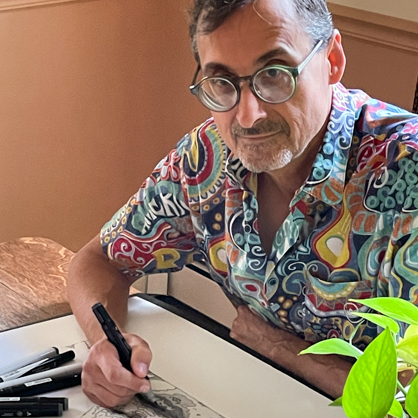
“So aside from your choice in coffee and pet peeve, what happens in the day-to-day life of Professor James Ayers? Do you secretly deadlift 225 lbs?”
Professor Ayers: “......not anymore.”
Author lets out a Yoda-like giggle. New lore unlocked?
“I like to walk,” Professor Ayers tells me. “Uhm, I have hobbies. I mean, I played drums.”
This question led to a conversation I wasn’t expecting. Apparently, Professor Ayers had originally planned on going to art school, but due to the financial instability of the field, he decided that a career in biology would be better in the long-term. As someone else who gave up a career in the visual arts, I understood where he was coming from. Prof. Ayers went on to tell me that he used to be in a band, but he has since left and diverted to doing weekly jam sessions. Outside of music, he is still an artist at heart and enjoys flipping comic books in his spare time.
There is such a unique balance to strike between school, work, and play. Then comes rest and fulfilling basic human needs, but don’t our hobbies fall into that category? So much of what we love doing tends to fade while we’re in school, and with that our drive to experience life. I’ve definitely found that as I got older, my enjoyment of things – art, ice cream, running at the park, reading – has definitely decreased merely because I don’t have time to really do it anymore. That’s the thing about college that I dislike. Who do you become when your life is simply paperwork? Equations? Long hours of studying and not touching the grass every once in a while? Certainly not anybody you’d recognize years beforehand.
If you’ve been doing homework for a while, go outside. Breathe some air in and stretch. Remember that you are still an animal, and that play is an essential thing for your biology. Do something fun, even if it’s small. Fold some origami. Call a friend and talk. Do anything that makes your heart lighter, and your soul a bit brighter.
Author, tapping her fingers on her keyboard. “You know, what’s something that people assume about you?”
Prof. Ayers tapped his fingers together for a moment before answering. “Everybody kinda thinks I’m even-keeled.”
I couldn’t disagree with that. I’ve found that people tend to believe others are more balanced, probably because we see in others what we want to see in ourselves. That’s why we admire people, I think; we value the people who we dream we could be. While I never had a role model growing up (i.e. Abraham Lincoln or any of that genre of leaders), I found that a lot of my admiration came in the form of other people, leading me to strive to be better.
I was also one of the kids who viewed everything as a competition. I am still that kid, lol.
“So, wrapping this interview up, here are my last two questions for you.”
“A±ô°ù¾±²µ³ó³Ù.”
“What advice do you have for students, and what’s the greatest life lesson you’ve learned so far?” I asked.
Leaning back in his chair a little bit, I could see the mental clockwork of Professor Ayers’ brain ticking away.
“People spend too much time in the past,” he stated. “Things happen and people don’t move on from it. As for ‘greatest life lesson,’ be wary of the pains of other people.”
That stuck with me.
I think human suffering and pain often start with our inability to let things go. Pain is contagious; it passes from person to person, seeping in through your skin and to your brain. How often do past mistakes leech into the present moment, telling you all the things you’re horrible at or have failed? Failure is never supposed to be a deterrent; it’s supposed to encourage you to do better. Nothing great was accomplished without challenge, adversity, some tears (probably), and as much perseverance as you could muster.
People will say that you will fail, but what they never tell you is that you have an option to get back up. There is always an option to get back up and try again.
Pick up the towel after throwing it in. Keep going. If you don’t, you may never know what you could’ve accomplished.
Fight for it.
I hope that everyone is having a great week, and that this interview has given some insight into the things you may have needed to hear.
With peace, love, and peanut butter,
Beatrice
Contact
Get the highlights!
Stay up to date with our weekly e-newsletter, highlighting stories from around the University and media clips featuring our faculty experts.