
Panelists from Yale New Haven Health, Gaylord Hospital, and Optimus Healthcare visited the University of New Haven’s School of Health Sciences to discuss the most pressing issues shaping access and affordability in today’s healthcare system.
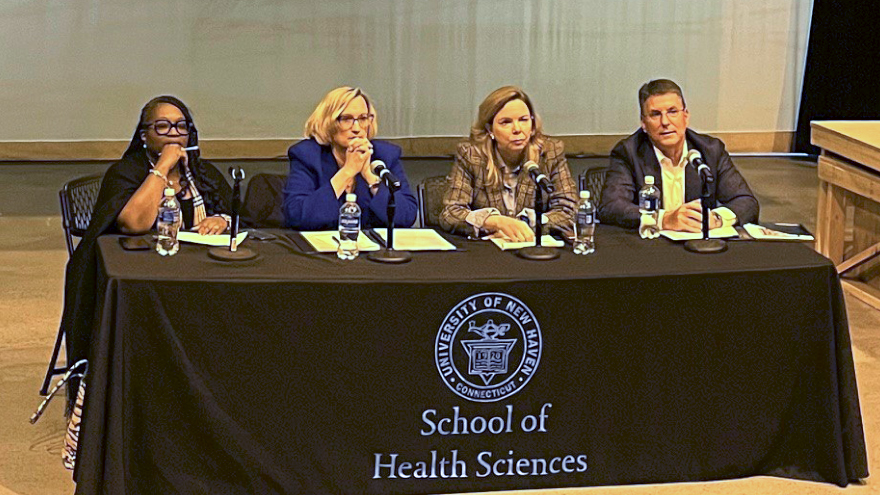
The University of New Haven’s recently hosted a thought-provoking panel discussion titled, “Current Challenges in Healthcare: Affordability and Accessibility.” The event, held in Bucknall Theater, brought together prominent leaders from across the healthcare landscape, including Deremius Y. Williams, senior vice president for payer strategy and innovation at Yale New Haven Health; Karen Daley, chief operating officer and general Counsel at Optimus Healthcare; Sonja LaBarbera, president and CEO of Gaylord Hospital; and Dave Fusco ’93 M.S., principal of Entracte Advisory Group LLC, who moderated the event. The conversation examined the intersecting challenges of cost, access, and equity in the U.S. healthcare system.
Students from the attended the discussion to learn directly from practitioners and policy leaders about how financing models, social determinants, and innovation influence care delivery and outcomes.
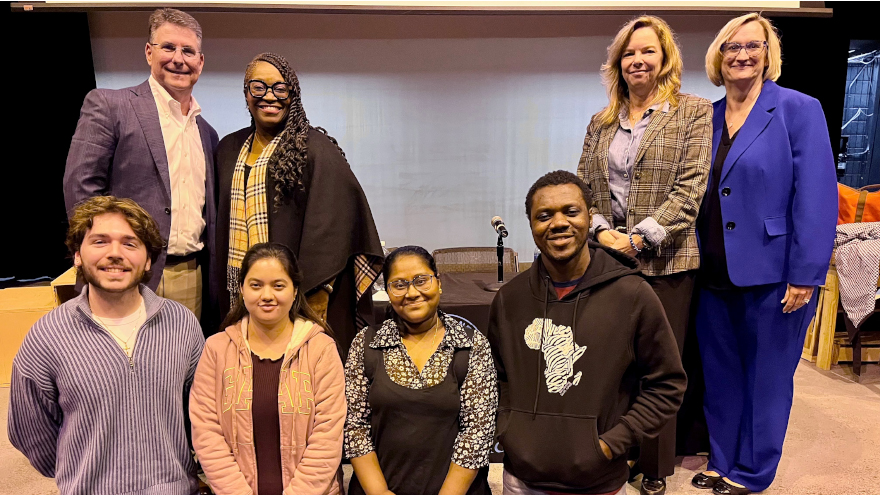
Below, three MPH students, Pooja Arugula ’27 MPH, Joshua Dennis Krah ’27 MPH, and Chandira Malla ’27 MPH, share their reflections on what they learned and how the experience deepened their perspectives on advancing affordability and accessibility in healthcare.
Through this panel, students gained a deeper appreciation for how affordability, accessibility, and quality intertwine within the nation’s complex healthcare system. As Joshua summarized, “Healthcare is not a competition arena – it is a team sport.”
Their reflections underscore a shared belief that meaningful progress requires collaboration, transparency, and a collective commitment to ensuring that healthcare is not a privilege, but a right for all.
Contact
Get the highlights!
Stay up to date with our weekly e-newsletter, highlighting stories from around the University and media clips featuring our faculty experts.
Pooja Arugula ’27 MPH
Listening to the panel discussion changed my perception of the U.S. healthcare system and what “quality care” really means. A moment that stood out to me was the description of the difference between fee-for-service and value-based care as “paying for effort” versus “paying for outcomes.” That analogy helped me understand why many patients sometimes feel like they are treated as numbers rather than people.
The discussion on payer mix and access also revealed inequities within the system. Two patients can receive the same service yet generate vastly different reimbursements depending on whether they are covered by Medicaid, Medicare, or commercial insurance. This not only affects patients but also challenges the financial stability of hospitals that serve vulnerable communities.
I also appreciated the emphasis on integrated care – addressing physical and mental health together rather than separately. The event encouraged me to think beyond individual patient encounters and to focus on systems that promote prevention, equity, and holistic wellbeing. My key takeaway is that healthcare must evolve from treating illness to building systems that foster health and ensure equitable access for all.
Chandira Malla ’27 MPH
Attending and participating in the discussion gave me detailed insight into healthcare payment models and value-based care, expanding my understanding of how financial structures shape both the delivery and outcomes of healthcare in the United States. I was impressed by how candid the panelists were in acknowledging that the system can be broken, frustrating, inefficient, and expensive, yet still capable of producing wonderful and inspiring results.
One statement that truly stayed with me was when a panelist said, “Four people can walk into the same clinic and pay four different prices for the same service.” That comment made me reflect on how inequitable our system can feel from a patient’s perspective. The discussion also shed light on how financial strain affects both patients and providers: families face high premiums and copays, while healthcare organizations grapple with rising labor costs and workforce shortages.
I was particularly intrigued by how technology and telemedicine are revolutionizing healthcare delivery. The integration of virtual visits, urgent care, and behavioral health services is creating new ways to improve access and efficiency, though challenges with digital inequity persist for low-income populations. The panel reinforced my conviction that healthcare must remain mission-driven and equity-focused. True progress requires transparency, collaboration, and a willingness to align economic considerations with humanity.
Joshua Dennis Krah ’27 MPH
As an MPH student with a background in medicine, I was struck by the revelation that only about five percent of U.S. health spending goes toward public health activities and primary care. That statistic helped me connect the dots between America’s high spending and its comparatively poor health outcomes. Sitting through the discussion, I realized that the challenges of affordability and accessibility are closely tied to social determinants of health, particularly access and quality of care.
The cost of healthcare remains a major barrier. I recalled a graduate-student friend who once needed emergency care and later dreaded the bill that followed. Her story embodies how cost can deter people from seeking care. To make healthcare truly accessible, I believe we must advocate for equitable, comprehensive health insurance that ensures everyone, regardless of income, race, or geography, can obtain care tailored to their needs.
The discussion also highlighted how limited funding for prevention and primary care discourages wellness-oriented practices. As the number of primary care physicians dwindles, emergency departments become overwhelmed, increasing costs and worsening outcomes. I was encouraged, however, by the conversation around virtual care and telehealth. Expanding both internet-based and telephonic methods could extend healthcare access to underserved populations. Overall, the event reinforced my belief that collaboration among stakeholders – government, insurers, providers, and the public – is essential to improving affordability and access for all.